Testing Beyond Service Life: Our In-House Pump and Controller Simulators
A lubrication controller that fails in the field takes a machine with it. So before any controller or pump leaves Montague Gardens, it has already been run, loaded, fault-injected and cycled on a purpose-built simulator — well past the service life it will ever see on a customer’s equipment.
Why we build our own test rigs
Bench testing a controller by powering it up and watching the display tells you almost nothing. Real installations do not fail that way. They fail when a pump motor draws more current than expected on a cold morning, when a proximity switch stops reporting, when a reservoir runs low, when a chafed cable shorts, or when ignition is switched off mid-cycle and the unit has to resume cleanly.
None of that is reproducible by hand. So we built rigs that reproduce it on demand, repeatedly, and record how the electronics behave.
The A2 Pump Simulator
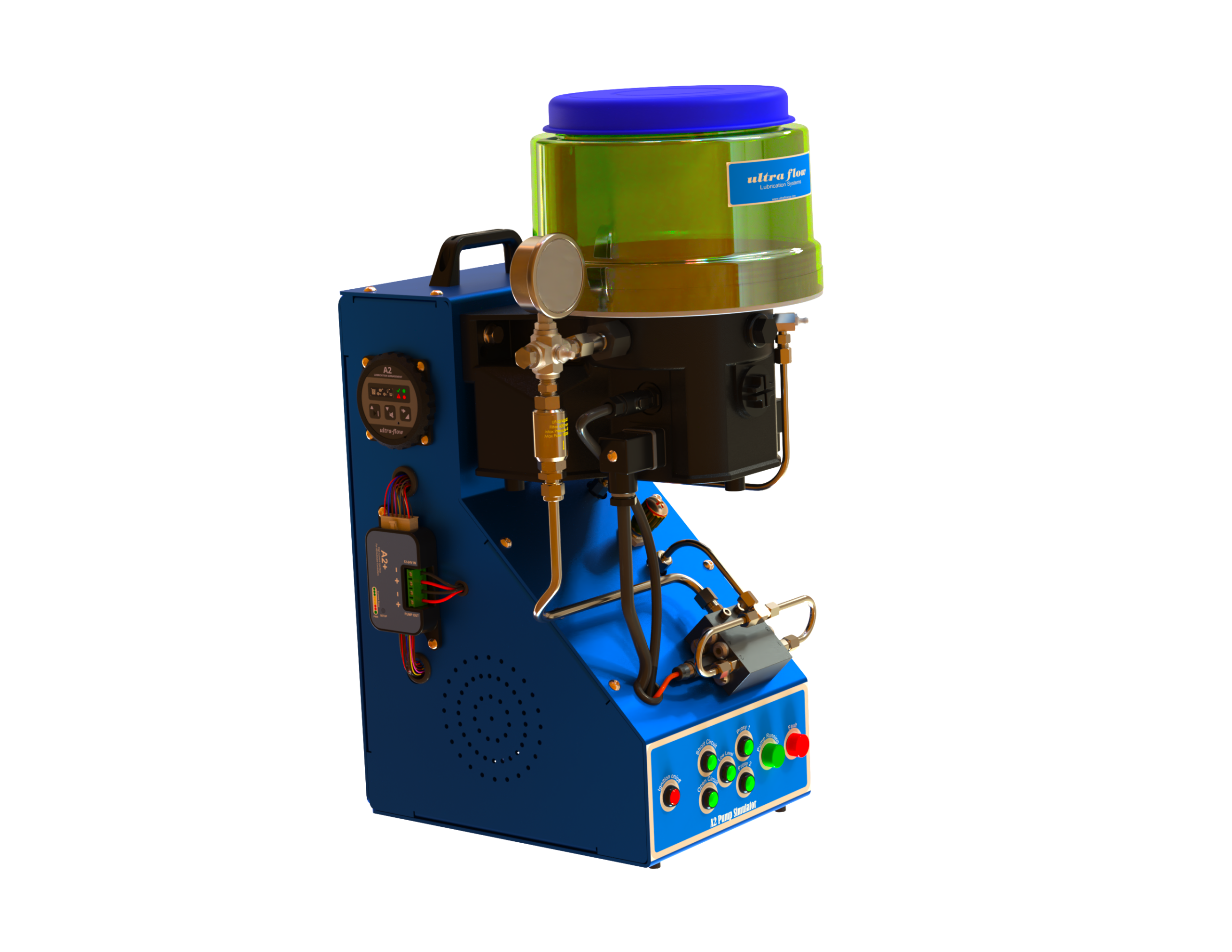
Our pump simulator is a complete working lubrication system on a stand: an Ultra-Flow reservoir and pump, pressure gauge, adjustable relief valve, divider block and return line, driven by an A2 Lubrication Management controller with an A2+ high-current pump driver module alongside it.
What makes it a test rig rather than a display piece is the fault panel. Every condition the controller is designed to detect can be injected at the press of a button:
- Ignition on/off — interrupting a cycle mid-stroke and confirming clean resumption
- Short circuit and open circuit on the pump output
- Low level detection from the reservoir
- Proxy 1 and Proxy 2 — proximity switch signals confirming or withholding divider block cycle feedback
- Pump running and fault annunciation
Because the rig plumbs a real pump into a real divider block against a real relief valve, the controller is not driving a dummy load. It is driving grease against pressure, which is the only condition in which motor current, timing and pressure feedback behave honestly.
The A2 Controller Simulator
Alongside the pump stand we build a portable controller simulator in a sealed case — an A2 controller, ammeter, pump motor and 220 VAC supply with a switch bank that applies selectable motor loads and fault conditions: 1 amp and 1.5 amp motor load, short circuit, open circuit, proximity sensor 1 and 2, low level detection and ignition switch off. A Roamer comms port allows the GSM module to be exercised on the same rig.
Two motor-load settings matter more than they appear to. A controller that switches a 1 amp load cleanly may behave differently at 1.5 amp, and the difference shows up in relay and driver longevity long before it shows up in function.
Cycling past expected service life
The rigs run continuously. A controller under test accumulates cycles far faster than it would on a machine, which lets us compress years of duty into a test window and see what wears: relay contacts, driver stages, connector seating, and the pump elements themselves under repeated pressurisation.
The point is not to prove the unit works. It is to find the point at which it stops working, and to make sure that point sits well beyond anything a customer’s equipment will demand of it.
[Ultra-Flow to insert the cycle counts and test durations achieved on the rigs — the specific figures make this section considerably stronger.]
In-house, on purpose
The rigs exist because assembly and testing happen in the same building. Our controller range is designed and assembled at Montague Gardens under an ISO 9001:2015 quality management system, with precision CNC machining alongside — so a divider block, a mounting plate and a test fixture are all made in-house.
That has a practical consequence for customers. When a fault is reported from the field, we can reproduce it on a rig rather than speculate about it. A condition described over the phone becomes a button press, and the behaviour is either confirmed or ruled out the same day.
What the rigs also do
Once a design is proven, the same rigs earn their keep in three other ways. They train installers and maintenance staff on setup, menu navigation and fault interpretation before anyone touches a live machine. They demonstrate to customers exactly how a system behaves when something goes wrong — far more convincing than a datasheet. And they serve as the reference against which returned units are compared.
Ask to see one
If you are specifying lubrication equipment and want to understand how a controller handles a blocked line, a dry reservoir or a failed proximity switch, we would rather show you than tell you. Speak to an engineer about a demonstration, or browse the controller range.