Fleet Lubrication for Long-Haul Transport
Long-haul transport is the application Ultra-Flow has installed more than any other. From 1989 onwards, the bulk of our Western Cape installation work was fitting automatic lubrication to truck and trailer fleets running national routes — more than a thousand installations by our senior installation team alone.
The challenge
A long-haul tractor-trailer combination carries between twenty and forty grease points: fifth wheel, king pin, spring pins, brake camshafts, slack adjusters, steering linkages and trailer suspension. On a manual regime every one of them depends on a technician with a grease gun finding the time, and finding the nipple.
In practice, three things go wrong. Points that are awkward to reach — inboard brake camshafts, rear trailer axles — get skipped. Vehicles on the road for weeks at a time miss their interval entirely. And when greasing does happen it happens cold and stationary, which is precisely when grease is least able to travel into a loaded bearing.
The failures that follow are rarely dramatic. They show up as king pin play at roadworthy testing, premature spring pin wear, seized slack adjusters and brake imbalance — each one an unplanned workshop day for a vehicle that only earns money while it is moving.
The system
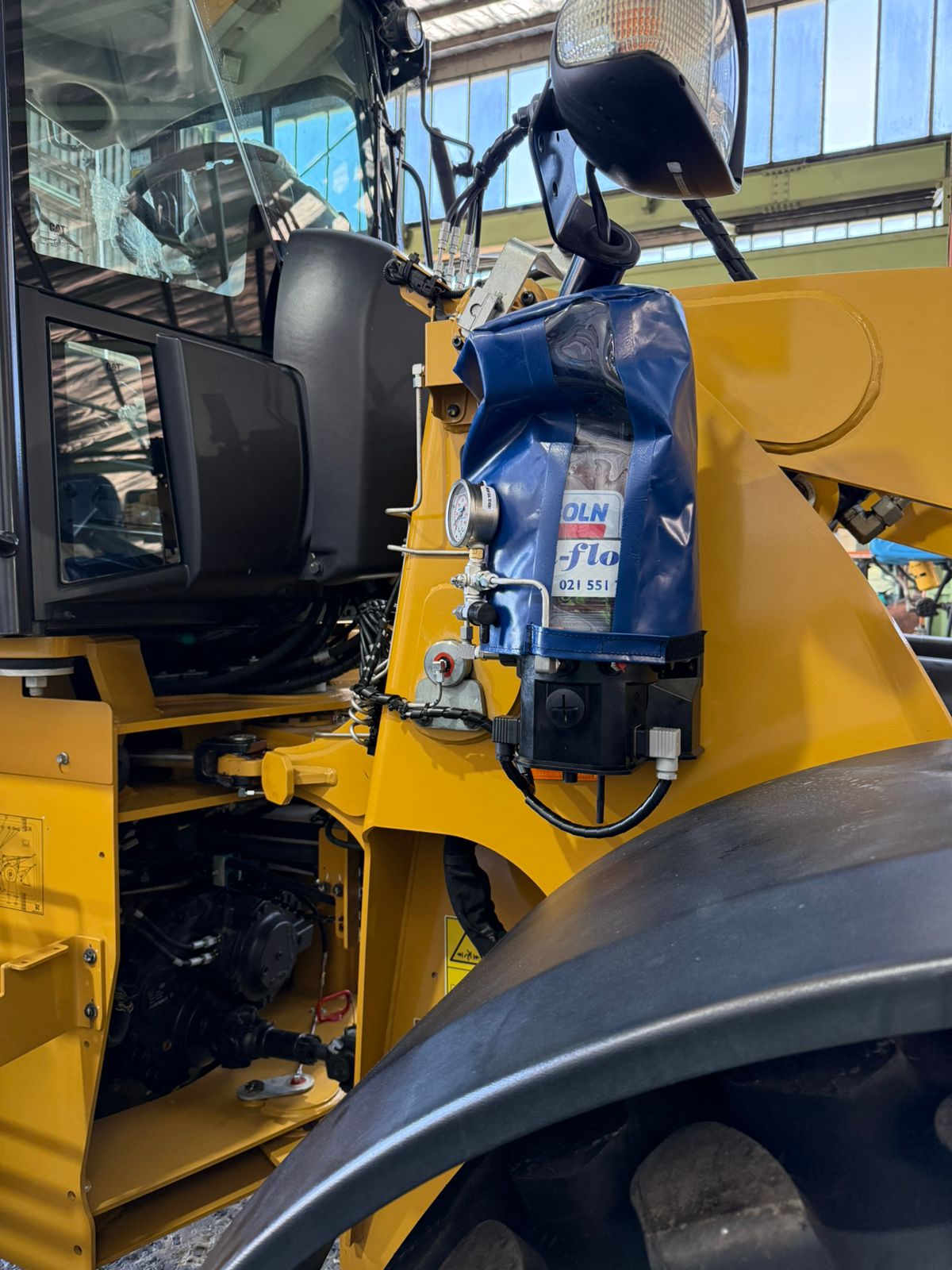
Ultra-Flow specifies a progressive (series-progressive) system for vehicle work. A single electrically driven pump feeds a master divider block, which feeds secondary blocks distributed along the chassis and trailer. Each outlet is piped to one grease point.
The defining property of a progressive system is that its divider elements are mechanically interlocked: pistons must cycle in a fixed sequence, and each can only move once the one before it has completed its stroke. If any single outlet blocks, the whole block stalls. There is no partial delivery and no silent failure — a fault anywhere is a fault everywhere, and it is detectable.
That property is what makes verification possible. A proximity switch on the master block reports piston movement back to the controller, so the system does not merely run a pump on a timer — it confirms that lubricant actually reached the points.
Control and timing
Vehicle systems are timed on running hours rather than calendar time, so lubrication tracks actual duty. Ignition-switched power means the controller counts only while the vehicle is working, and delivery happens warm and under load — the condition in which grease distributes properly.
For fleets standardising on one platform, the A2 Autolube controller handles cycle management, level and pressure monitoring and visual fault alarms, with Bluetooth for setup and diagnostics so a technician can interrogate a unit without opening the cab. Where a simpler duty applies, the Autolube digital controller gives quick-key seconds/minutes/hours timing with LED status for pump, proximity switch and reservoir. The G1 remains a cost-effective dial-set choice for single-pump installations.
Commissioning
Every installation is proved point by point at handover: each outlet is cracked and confirmed to pass grease, the master block is verified cycling on the proximity switch, and interval and dispense settings are set against the operator duty cycle rather than a default. The fleet receives the point schedule and controller settings as the maintenance record.
What to look for on your own fleet
If you are weighing up automatic lubrication, the evidence is usually already in your workshop records. These are the signatures worth checking:
- King pin play at roadworthy testing on vehicles well short of expected life — almost always a lubrication interval problem rather than a component quality one.
- Wear concentrated on one side of a trailer or on rear axles. Uneven wear across identical components points to points being reached inconsistently, not to loading.
- Seized or stiff slack adjusters and the brake imbalance that follows. These sit in the awkward-to-reach category and are the first to be skipped.
- Grease consumption that does not match the fleet size. If the store issues far less than the point count and interval imply, the greasing is not happening.
- Repeat failures on the same position across different vehicles — a strong indicator of an access problem rather than a driver or route problem.
Any two of these together generally justify costing an automatic system against the workshop days those failures consume.
Equipment specified
- Electric grease pump, 12/24V DC, chassis mounted with low-level switch
- Master and secondary progressive divider blocks, outlets sized per point
- Proximity switch on master block for cycle verification
- A2 Autolube, Autolube digital or G1 controller to suit fleet standard
- Nylon and steel feed lines with protective sleeving through chassis runs
- Push-Lok stainless fittings at service points
Talk to us about your fleet. Ultra-Flow designs, manufactures and installs from Montague Gardens, Cape Town, and has been fitting vehicle lubrication systems in the Western Cape since 1989.